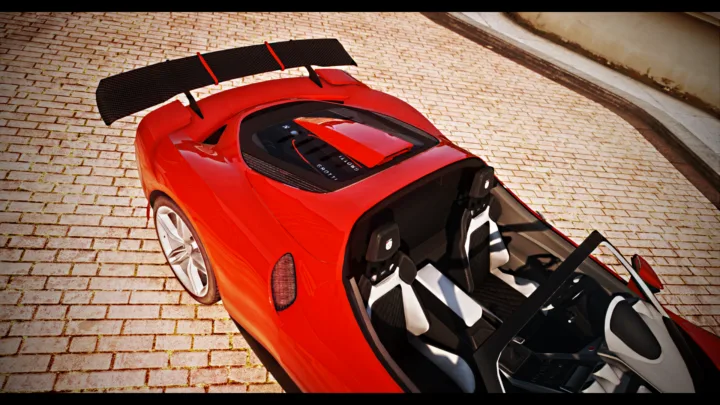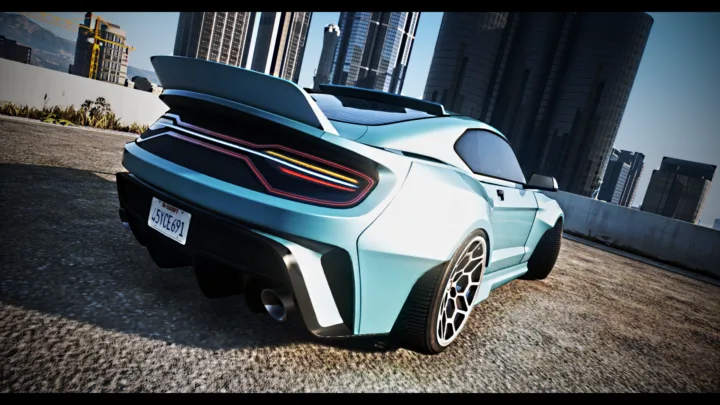
Every FiveM car meet I've dropped into lately looks like the same photograph. Eight Japanese silhouettes, forty variations on them, and one lonely Gauntlet parked at the far end of the lot where somebody has already asked its owner when he's saving up for a real car. He can afford whatever he wants. He picked a two tonne coupe with three gears and brakes roughly the size of a beer mat, on purpose, and he'd quite like the server to stop treating his half of the garage as the clearance aisle. FiveM muscle cars are a scene with their own physics, their own events and their own crowd, and most servers never build it because nobody ever explained how.
So here's the other side of the garage: what the muscle feel actually is in handling terms, which Rockstar cars to build on before you spend a penny, why restomods beat period-correct on a roleplay server, the formats that reward torque instead of lap times, the audio question, and how to keep the class honest against the import crowd.
What makes FiveM muscle cars feel like muscle
Four sensations, and every one of them is a number in a file.
Power arrives at the bottom. An import builds speed as the revs climb; a muscle car has already given you everything it has by the time you've finished saying "second gear". Weight is the one people underrate: you are managing momentum rather than exploiting agility, so you commit to a direction change one corner earlier than you would in a hatchback. Third, the brakes arrive late. You brake before the marker, not at it. Fourth, traction is a suggestion the rear tyres are free to ignore.
The handling.meta fields that carry that character
fMassis the foundation. Rockstar's muscle cars sit roughly in the 1700 to 1900 kg band where a light import is nearer 1400, and no amount of grip tuning fakes the feeling of moving that much metal.vecInertiaMultiplierscales rotational inertia per axis, so raising it makes the car resist changing direction. Almost nobody touches it, and it's where "plan the corner early" actually lives.fInitialDriveForcegoes up,nInitialDriveGearsgoes down to three or four, andfInitialDriveMaxFlatVelsets where the gearing tops out. Long gears mean the car pulls and pulls in third instead of machine-gunning through shifts.fDriveInertialower makes the engine rev lazily, which is how you get big-displacement feel rather than a superbike in a Camaro body. DropfClutchChangeRateScaleUpShifttoo, so each shift takes a beat instead of firing like a dual-clutch.fLowSpeedTractionLossMultis the burnout dial. Raise it and the rears light up from a standstill, which is most of the personality in one field.fTractionCurveLateralshould sit below your import numbers so the car gives up at a smaller slip angle, while the gap betweenfTractionCurveMaxandfTractionCurveMindecides whether a slide is catchable or a one-way trip into a lamp post.fBrakeForcecomes down andfBrakeBiasFrontmoves slightly forward, so the nose dives and the car pushes wide when someone brakes too late. Stock road cars sit around 0.6 to 0.8, sports and supers higher; you want the bottom of that.fSuspensionCompDamp,fSuspensionReboundDampandfAntiRollBarForceall softened buys you body roll and float over crests, which is free character.
Tune one field at a time and restart the resource between changes, or use an in-game handling editor and bake the final values back into the file afterwards. For the full field-by-field reference rather than my shortlist, the handling.meta breakdown over on cars-tebex.io goes deeper than I have room for.
Build the scene on Rockstar's muscle cars before you buy anything
The best value in fivem muscle cars is sitting in your base game already, and the class maps onto Detroit more cleanly than people realise. Vapid is Ford: the Dominator line is the Mustang, the Ellie is the early-70s fastback, the Hotknife is a '32 rod. Declasse is Chevrolet and the wider GM side, so the Vigero is the Camaro, the Tampa is Chevelle and Duster territory, the Sabre Turbo is a Chevelle SS. Bravado is Dodge, which makes the Gauntlet Classic a 1970 Charger with the badge quietly filed off. Imponte covers Pontiac and Plymouth, so the Ruiner and Phoenix are your Trans Am, and the Dukes is a '69 Charger in an orange paint scheme everyone over thirty will recognise instantly. Albany and Willard handle Cadillac, Buick and Oldsmobile, which is where the Buccaneer, the Faction and the lowrider branch of the family live.
That matters more here than it does for imports. Going lore-friendly on a Japanese scene means real substitution, because Rockstar's Japanese catalogue has gaps. Going lore-friendly on American iron costs you almost nothing. You lose the badge and you keep the car.
Real-badge add-ons still pull, obviously. They photograph better and they're what players ask for by name. The cost is a fleet that can evaporate, and when a manufacturer takedown lands it doesn't arrive as a warning, it arrives as a missing folder. My working rule: the backbone of the scene is lore-friendly, and real-badge cars are garnish you can afford to lose. If a car vanishing would break three players' entire character concept, that car should not be real-badge.
One trap regardless of which way you go. Every add-on needs <vehicleClass>VC_MUSCLE</vehicleClass> set correctly in its vehicles.meta, or your class-filtered races and dealership categories will never see it. Packs that ship everything as VC_SPORT are common, and they break class events silently.
Restomods are the muscle cars people actually drive
Full period-correct is a trap on a roleplay server. A car with authentic 1970 brakes and authentic 1970 grip is a delight for two evenings and then lives in the garage forever, because your server is not a museum, it's a place where police chase people down a freeway with traffic in it. Losing a pursuit because your car stops like a shopping trolley full of bricks is funny exactly once.
The restomod fix is a handling philosophy: keep the character fields, repair the liability fields. Leave fMass heavy, fLowSpeedTractionLossMult high and fDriveInertia lazy. Then bring fBrakeForce up toward sports-car numbers, tighten the suspension damping, raise fAntiRollBarForce, nudge fTractionCurveMax up a little, and give it five or six gears instead of three. What you get is still heavy, still lights the rears, still needs planning, and now survives contact with an actual road.
It solves a modelling problem too. A modern wheel and tyre package, a settled stance and a visible brake caliper behind the spokes are the difference between a 55-year-old shape reading as "built" and reading as "found in a barn", and that's mod-slot work rather than a new model.
Pre-1980 classics deserve their own night
A 1970 big-block coupe and a 1958 cruiser attract completely different people. Lump them into one category and nobody's happy. Split them and you get two crowds who turn up on different evenings, which is twice the content for the same map.
GTA already splits them for you: most pre-1980 material sits in Sports Classics rather than Muscle, so the Roosevelt, Peyote, Tornado, Manana, Retinue and Coquette Classic filter cleanly into their own events. That crowd wants lower speeds, cruises instead of races, decent photo locations, period plates and a workshop that isn't lit like a nightclub. Their content is the photograph. Put them in a drag bracket and they'll politely never come back.
Roll racing and quarter miles beat lap times for muscle
Circuit racing and drift both reward the light car, which is exactly why the muscle crowd never shows up to your race nights. Give torque a format where it's the point.
Roll racing is the purest one. Two cars roll at an agreed speed in an agreed gear, someone calls it, and the first to pull a car length wins. The whole contest is who has grunt where they're sitting, which is home turf. Los Santos already has the geography: the Senora Freeway, the Great Ocean Highway and the long Route 68 straights all work.
Quarter miles need 402 metres and a runway. LSIA and Fort Zancudo are the traditional strips, and the road past the Palmer-Taylor power station is a decent third. Scripting it is straightforward: #(startCoords - GetEntityCoords(veh)) gives you distance in metres, GetGameTimer() gives you milliseconds for the ET, and GetEntitySpeed(veh) returns metres per second, so a trap speed readout is one multiplication away. Add a staged light sequence and a reaction time and you've got a bracket night.
Cruise nights and show-and-shine round it out. A cruise is a slow convoy on a route worth looking at, with staggered departures so streaming keeps up. A show is judged on the build rather than a stopwatch, with categories like period-correct, best restomod and best paint, scored by a panel of three so it doesn't collapse into a popularity vote.
Both need a venue that reads as an event. Twenty cars in an empty car park look like twenty cars in an empty car park; barriers, light towers, a start gantry and spectator seating turn the same spot into a strip, and prop dressing is the cheapest atmosphere money can buy. The exterior props and city dressing set on assets-tebex.io exists for exactly this job. On the script side, if you want brackets, class filters and real timing rather than a mate counting down in voice chat, the racing server build guide on cfxtebex.store covers the pieces.
A V8 that sounds like a vacuum cleaner ruins everything
Nothing torpedoes a muscle build faster than four-cylinder audio. Spend a fortune on the model and the tune, and a wheezy engine sample undoes all of it in four seconds flat.
If you're not shipping custom audio, at minimum set audioNameHash in vehicles.meta to a game vehicle with the right note. DOMINATOR, GAUNTLET, PHOENIX, SABREGT, RUINER, BLADE and DUKES all give you a credible V8 for free. This is the step add-on authors skip most often, and it's why so many gorgeous American cars arrive sounding like a hire-car Blista.
Custom packs are the better answer: .awc wave banks plus dat151 and dat54 config, wired explicitly in fxmanifest.lua.
data_file 'AUDIO_GAMEDATA' 'audioconfig/bigblock_game.dat'
data_file 'AUDIO_SOUNDDATA' 'audioconfig/bigblock_sounds.dat'
data_file 'AUDIO_WAVEPACK' 'sfx/dlc_bigblock'
Those three lines can't be globbed, so every pack needs its own set. Miss them after a merge and you get beautifully silent cars.
Half of what people hear as "V8" is actually the gearing, mind. Three long gears means the note holds one continuous pull per gear instead of chattering through a shift every second and a half. That's handling.meta doing audio work.
Keeping muscle and imports honest against each other
A class that's strictly worse is a costume rather than a choice. A class that's strictly better just changes which eight cars fill the lot. Both outcomes waste the work.
The clean split is by where the win happens. Muscle takes it in a straight line, from a roll and off the line from a dig. Imports take it wherever the road bends. In fields: muscle carries more fInitialDriveForce and a higher speed ceiling, and pays with fMass, vecInertiaMultiplier, less fTractionCurveLateral and less fBrakeForce. Imports get the mirror image.
Then test it instead of trusting the theory. Three routes: a long freeway roll, a canyon section with real corners, and a technical city loop full of braking zones. Any car winning all three is broken. Any car losing all three is an ornament. Run that pass before the cars hit the dealership, not after somebody posts a damning lap chart in your Discord at two in the morning.
Seed the scene with three cars, not a sixty-car pack
The instinct is to buy a big pack of fivem muscle cars and let players sort it out. That fails twice. Streaming memory is the obvious one: every add-on vehicle is model and texture memory you spend whether anyone drives it or not, and stacking hundreds of high-poly cars is a well-trodden route to missing textures and five-minute joins. The social failure is worse. If everyone owns a different car, nobody shares a reference, and shared references are the entire substance of a car scene.
Pick three. A late-60s big-block coupe as the hero. A malaise-era T-top as the cheap entry, priced so a new player can join on their first paycheck. A restomod pickup or wagon as the oddball, because every real scene on earth has a truck guy. Price them so five people can own each, then give them somewhere to be: a garage MLO, a weekly night and a named route.
When players start asking for a specific fourth car by name, buy the fourth car. That request is your proof the scene exists. Buying sixty cars before it just builds a car park with a login screen.
Three cars, one heavy tune, a night, a strip with some lights on it, and engines that sound like they've got eight cylinders in them. Do that and the bloke in the Gauntlet stops being the punchline at the end of the lot and starts being the reason a second crowd logs in on a Tuesday. He'll still lose the canyon run. He'll just win the roll on the way home.