What makes a FiveM drift car actually drift
FiveM drift cars are built in handling.meta, not in Blender. A drift-ready car is rear wheel drive, runs lowered peak grip with a narrow drop to its sliding grip, carries extra steering lock for counter-steer, and makes enough torque to keep the rear tyres spinning through a transition. The model is just the part that poses for the clips.
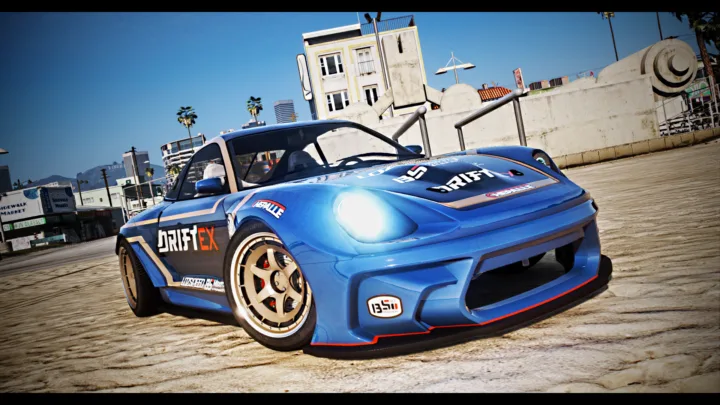
The market gets this backwards constantly. Plenty of packs sell a gorgeous S-chassis with kit and camber that drives like a shopping trolley on rails, because the seller shipped it with stock-style road handling. Grip is great for RP commuting. It's useless for holding a third-gear slide through the docks. So before you judge any drift car by its screenshots, judge it by its handling line.
The handling.meta values behind a proper slide
Here's the short list of fields that decide drift behaviour, and what each one actually does:
fDriveBiasFrontsets the drive layout.0.0is fully rear wheel drive,1.0is front wheel drive. Drift cars live at0.0, no exceptions and no debate.fTractionCurveMaxis peak grip before the tyres let go. Most stock sports cars sit in the low-to-mid 2s. Drift tunes pull this down so the rear breaks away on demand instead of fighting you.fTractionCurveMinis grip after breakaway, the number that owns the actual slide. The gap between Max and Min is the real story: a wide gap means the car snaps loose and spins, a narrow gap means it lets go progressively and stays catchable.fTractionCurveLateralshapes the lateral grip curve. Peak grip lands at half this value in degrees of slip, so raising it keeps the car pulling at bigger angles instead of giving up the moment it steps out.fLowSpeedTractionLossMultcuts traction at low speed.0.0means full grip off the line, higher values make it easy to light the rears from a dig. This one field is most of the difference between a burnout machine and a traction-control sedan.fSteeringLockis the maximum steer angle in degrees. Stock road cars carry roughly 35 to 40. Drift handling pushes past 50 so you have the counter-steer to catch big angle instead of pirouetting into the wall.fInitialDriveForceis drive force at the wheels. A drift car needs enough to keep the rears spinning mid-corner and through transitions, because the moment they hook up, your slide is over.fHandBrakeForcedecides how hard the e-brake locks the rears, which is your main entry tool at street speeds.
Two supporting notes. Weight matters, because fMass and the grip fields interact, and a two-tonne barge transitions like a two-tonne barge no matter what you do to the tyres. And tune one field at a time: handling edits only load on resource restart, so the sane workflow is an in-game handling editor for live iteration, then bake the final values back into the file. Guessing seven values at once and restarting is how people spend a whole evening making a car worse.
If you'd rather not hand-tune at all, that's a legitimate choice too. Plenty of vehicle packs on cars-tebex.io ship with handling already sorted per car, and buying a sorted line is cheaper than the hours you'd spend deriving one.
Baked drift handling vs drift toggle scripts
There are two ways to put drift physics in players' hands, and picking the wrong one for your server type causes grief.
Baked handling means the car's handling.meta is a drift tune, permanently. The car always slides, for everyone, identically. This is the right call for dedicated drift servers, because scoring only means something when every player's S15 behaves like every other player's S15. Consistency is the whole sport.
Toggle scripts flip a street car into drift mode on a keybind. The common implementations, roughly in order of elegance:
SetDriftTyresEnabled(vehicle, true)switches on the low-grip drift tyres Rockstar added in the Los Santos Tuners update. It's one native call and the behaviour is consistent, but it needs game build 2372 or newer, so check yoursv_enforceGameBuildbefore building around it.- Runtime handling edits via
SetVehicleHandlingFloat, where the script multiplies grip values down on toggle and restores them after. Free open-source examples of this pattern have been on GitHub for years, and paid versions mostly add polish, config and a nicer keybind flow. - Scripted traction tricks that leave the handling model untouched entirely, which keeps them compatible with other resources that also want to fiddle with grip.
Toggles are the right answer for RP servers. One garage car does both jobs, the owner can commute to their nine-to-five and then embarrass themselves at the Friday meet, and police vehicles don't inherit banana-peel physics mid-pursuit. If you're shopping for one, script stores like cfxtebex.store carry standalone drift and vehicle-control resources that drop in without touching your framework.
Tyre smoke, burnouts and looking the part
Smoke is the scoreboard the crowd can read. Mechanically it's simple: tyre smoke is vehicle mod slot 20, toggled with ToggleVehicleMod(vehicle, 20, true), and SetVehicleTyreSmokeColor(vehicle, r, g, b) tints it. Coloured smoke synced across a whole meet is a cheap, huge win for atmosphere.
Burnout behaviour ties back to fLowSpeedTractionLossMult from earlier. If cars on your server can't break the rears loose from a standstill, that value is why, and no smoke script will fake it.
One honest warning. Smoke is a particle effect, and particles are one of the few things in this engine that scale badly in a crowd. Ten cars holding a tandem train with tinted smoke will do more to frame rates than most people expect. Keep the effect, but remember it's part of your performance budget, not a freebie.
How to pick a drift pack that's worth paying for
Buying advice, in the order I'd actually check things:
- Open handling, always. Escrow on the model is normal. Escrow on
handling.metais a red flag, because a drift car you can't tune is a car you can't fix. Good sellers leave the metas editable even when the mesh is protected. - Real drift handling included. The listing should say the cars ship with dedicated drift tunes, or with a separate drift-spawn variant per car. "Drift pack" with stock-style handling is a tuner pack with better marketing.
- Add-on, not replace. Add-on cars keep their own spawn names and don't stomp base-game vehicles, which matters the day a job script or another pack expects the original.
- Debadged or lore-friendly options. Debadged JDM packs exist because servers got burned running branded replicas. Know your server's policy before you buy, not after.
- Optimisation you can verify. Look for stated poly counts, working LODs and sensible texture sizes. Vehicle cost isn't a resmon number, it's streaming memory and frame time near the car, and a "premium" model with no LODs taxes every player who parks next to it.
- Spawn name hygiene. Generic spawn names like
s15collide across packs. Prefixed names don't.
Running a drift meet that doesn't melt frame rates
Meets die two ways: nobody shows up, or everybody shows up. The second one is fixable.
- Curate the streamed catalog. Every add-on car is memory whether it's spawned or not, and merged 200-car mega-packs are how servers end up stuttering at the gate. Forty good cars beat two hundred mediocre ones.
- Watch texture bloat. A 4K livery per car across a full lot is VRAM you don't have. 2K skins read fine at meet distance.
- Pick the venue for performance. An open lot or a lean drift-circuit map holds a crowd far better than a detail-heavy interior. Purpose-built maps and MLOs from assets-tebex.io let you choose a venue that was optimised on purpose rather than herding thirty cars into a showroom built for five.
- Respect the particle budget. Tinted smoke on every car, remember, is part of the bill.
- Mind entity density. OneSync handles the player count, but stale spawned cars left around the lot add up. Clean-up scripts earn their keep at events.
The pattern across all of it: drift scenes run on consistency. Consistent handling so skill is comparable, consistent frame rates so entries are judged on angle rather than lag, consistent car quality so the meet looks like a meet. Get the handling line right first, budget the flash second, and the model can go back to doing what it does best. Posing for the clips.